



Hi there! I have put together a python package for analyzing single cell
BCR/TCR data from multiple platforms, including 10x Genomics 5’ VDJ,
BD Rhapsody, Parse Biosciences, SeekGene, and other AIRR-compatible
sequencing sources. It streamlines the
pre-processing, leveraging some tools from the immcantation suite, and
integrates with scanpy/anndata for single-cell BCR/TCR analysis. It also
includes a couple of functions for visualization. Try it out on !
Also check out our review at Nature Methods on “Single-cell immune repertoire analysis”:
Irac et al. (2021), Single-cell immune repertoire analysis, Nature Methods.
Overview
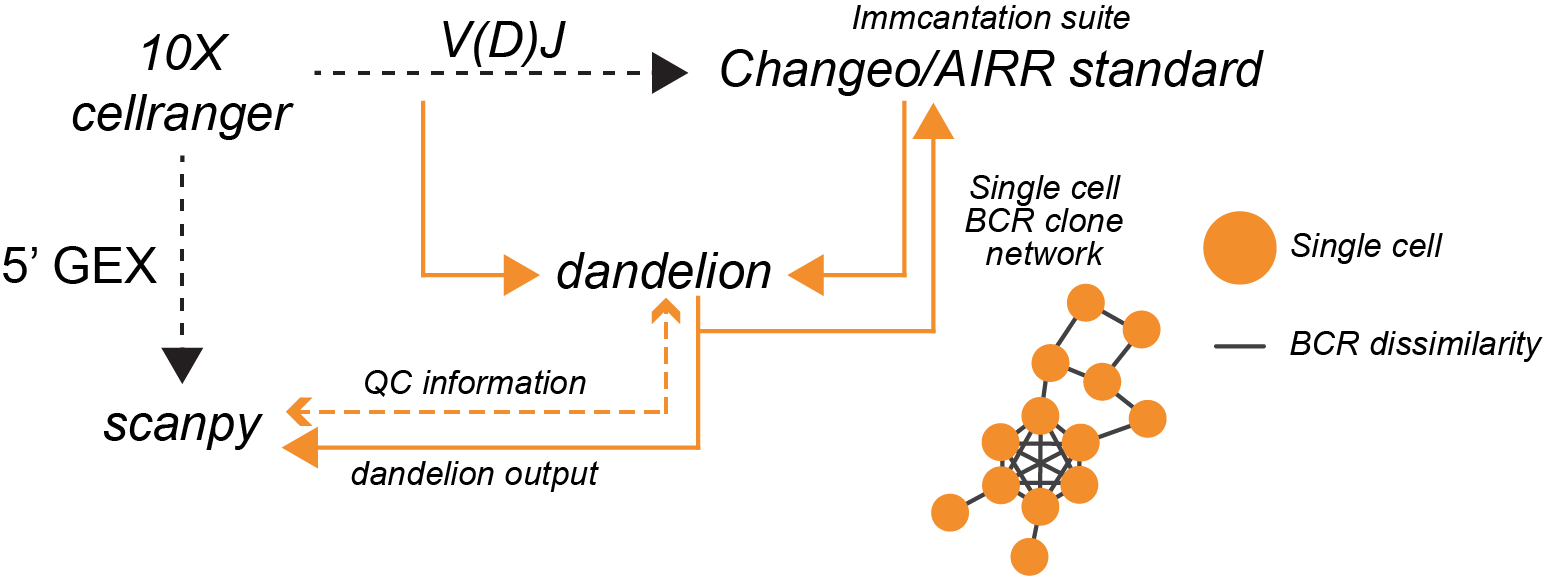
Illustration of the Dandelion class slots
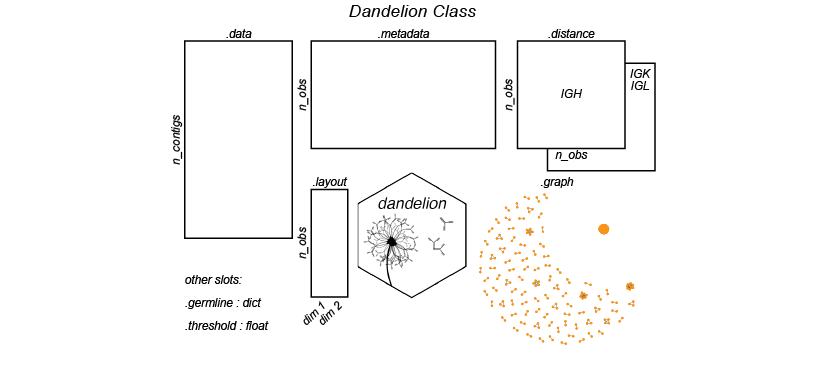
Please refer to the documentation or the notebooks here:
The raw files used in the example notebooks can be downloaded from 10X’s Single Cell Immune Profiling datasets website.
Installation
Container (Apptainer or Docker)
dandelion comes ready in the form of a container image with all the
required dependencies, tools (IgBLAST, BLAST, Change-O, TIgGER) and
reference databases installed. It is published on
Docker Hub and works
with Apptainer (typical on HPC; SingularityCE also works) as well as
Docker/Podman.
Apptainer: download the ready-made .sif image (fastest):
apptainer pull sc-dandelion_latest.sif oras://docker.io/zktuong/sc-dandelion:latest-sif
apptainer shell --writable-tmpfs -B $PWD sc-dandelion_latest.sif
or build the .sif locally from the Docker image (takes a few minutes and
a few GB of temporary space):
apptainer pull docker://zktuong/sc-dandelion:latest
Either way you get sc-dandelion_latest.sif, a container that has all the
required dependencies installed. To use a specific release instead of the
latest image, replace latest with the release tag (for example,
v0.5.0-sif for the ready-made image or v0.5.0 for the Docker image).
Using SingularityCE rather than Apptainer? The commands are identical: just
replace apptainer with singularity.
This can be used for the preprocessing steps by navigating to the data folder and use:
apptainer run -B $PWD sc-dandelion_latest.sif dandelion-preprocess
Docker/Podman:
docker run --rm -v "$PWD":/data -w /data --user "$(id -u):$(id -g)" \
    zktuong/sc-dandelion:latest dandelion-preprocess
Note
The image used to be hosted on the Sylabs Cloud Library
(library://kt16/default/sc-dandelion), which has been decommissioned.
Please update any scripts that use the old library:// address.
If you hit Docker Hub’s anonymous pull rate limit (common on shared HPC
login nodes), pull the identical mirror from the GitHub Container
Registry instead by replacing docker.io/zktuong with
ghcr.io/tuonglab, e.g.
apptainer pull sc-dandelion_latest.sif oras://ghcr.io/tuonglab/sc-dandelion:latest-sif.
If you build from the Docker image and your home directory is small,
point APPTAINER_CACHEDIR and APPTAINER_TMPDIR at scratch space
first.
Python package
Start off by creating a conda environment containing scanpy, following official scanpy instructions. Once done, run the following:
With Polars backend (recommended for improved performance):
pip install "sc-dandelion[polars]"
Base install:
pip install sc-dandelion
The polars extra enables a faster backend for data operations. The base install
uses pandas as the backend.
Between this and the pipelines within the container, you should be covered for most of your needs.
Manual full installation
For those who cannot use the container, here is a detailed installation guide. Instructions may vary depending on your system.
First, install igblast and blast:
conda install -c bioconda igblast blast
# if the above doesn't work, download them manually:
# https://ftp.ncbi.nih.gov/blast/executables/igblast/release/LATEST/
# https://ftp.ncbi.nlm.nih.gov/blast/executables/blast+/LATEST/
echo 'export PATH=path/to/igblast/bin:$PATH' >> ~/.bash_profile
echo 'export PATH=path/to/blast+/bin:$PATH' >> ~/.bash_profile
Download the germline databases using the
scripts
in the container folder:
python prepare_imgt_database.py
python prepare_ogrdb_database.py
Set the paths to the germline and igblast databases:
echo 'export GERMLINE=path/to/database/germlines/' >> ~/.bash_profile
echo 'export IGDATA=path/to/database/igblast/' >> ~/.bash_profile
echo 'export BLASTDB=path/to/database/blast/' >> ~/.bash_profile
source ~/.bash_profile
R packages for preprocessing
For some preprocessing steps you will need rpy2 and the following R
packages. The easiest way is via conda:
conda install -c conda-forge -c bioconda rpy2 r-optparse r-alakazam r-tigger r-airr r-shazam r-scoper
Alternatively, install rpy2 via pip and the R packages from within R:
pip install rpy2
# If compilation fails with clang, point to gcc first:
# env CC=/path/to/bin/gcc-9 pip install rpy2
install.packages(c("optparse", "alakazam", "tigger", "airr", "shazam", "scoper"))
Finally, install dandelion:
# recommended: polars backend for improved performance
pip install "sc-dandelion[polars]"
# or the base (pandas) install
pip install sc-dandelion
# or from GitHub
pip install "sc-dandelion[polars] @ git+https://github.com/tuonglab/dandelion.git"
pip install git+https://github.com/tuonglab/dandelion.git
# or from a specific branch
pip install git+https://github.com/tuonglab/dandelion@branch_name
Basic requirements
Python >=3.11
Base packages (auto-installed with pip install sc-dandelion)
numpy>=1.23
pandas>=1.4
changeo>=1.1
anndata>=0.9
scanpy>=1.9
scikit-learn>=1.0
scipy>=1.8
numba>=0.56
seaborn>=0.12
networkx>=3.0
leidenalg>=0.9
polyleven>=0.4
h5py>=3.6
adjustText>=0.7
distance>=0.1.3
plotnine>=0.10
palettable>=3.3
mizani>=0.8
matplotlib>=3.5
rapidfuzz>3.12.1
zarr>=2.18.7
circlify>=0.15.0
airr
Optional extras
pip install sc-dandelion[polars]    # polars>=2.0.0, pyarrow>=21.0.0
pip install sc-dandelion[scirpy]    # scirpy>=0.21, awkward>=2.1, mudata>=0.2
pip install sc-dandelion[scrublet]  # scrublet>=0.2, annoy<1.17.0
pip install sc-dandelion[palantir]  # palantir>=0.2.3, pertpy>=0.1.0, jax>=0.3
pip install sc-dandelion[dask]      # dask>=2025.11.0, distributed>=2025.11.0, psutil>=6.1.0
Other executables (required for preprocessing)
blast>=2.10.1   (bioconda)
igblast>=1.15.0 (bioconda)
Acknowledgements
I would like to acknowledge the contributions from Dr. Chenqu Suo, Dr. Krysztof Polanksi, Dr. Sarah Teichmann and Prof. Menna Clatworthy, who helped with the initial conception of the project and for all discussions.
I would also like to acknowledge Dr. Ondrej Suschanek, Dr. Benjamin Stewart, Dr. Rachel Bashford-Rogers, Dr. Jongeun Park, Dr. Cecilia-Dominguez Conde, Dr. Kirsten Stewart, Dr. Hamish King and Dr. Peng He with whom I have had very useful discussions. I would also like to thank my wife who helped name the package, because she thought the plots looked like a dandelion =D.
Support
Support is provided on a voluntary basis, as time permits.
If there are any ideas, comments, suggestions, thing you would like to know more etc., please feel free to email me at z.tuong@uq.edu.au or post in the issue tracker and I will get back to you.
Citation
Please also cite the following paper if you use version 0.3.0 onwards:
Suo et al. (2023), Dandelion uses the single-cell adaptive immune receptor repertoire to explore lymphocyte developmental origins, Nature Biotechnology.
Chenqu Suo, Krzysztof Polanski, Emma Dann, Rik GH Lindeboom, Roser Vilarrasa-Blasi, Roser Vento-Tormo, Muzlifah Haniffa, Kerstin B Meyer, Lisa M Dratva, Zewen Kelvin Tuong, Menna R Clatworthy, Sarah A Teichmann. Dandelion uses single cell adaptive immune receptor repertoire to explore lymphocyte developmental origins. Nature Biotechnology 2023.04.13; doi: https://doi.org/10.1038/s41587-023-01734-7*
The data used in the Nature Biotechnology papers can be found at a separate repository.
dandelion was originally published in:
Stephenson et al. (2021), Single-cell multi-omics analysis of the immune response in COVID-19, Nature Medicine.
Emily Stephenson, Gary Reynolds, Rachel A Botting, Fernando J Calero-Nieto, Michael Morgan, Zewen Kelvin Tuong, Karsten Bach, Waradon Sungnak, Kaylee B Worlock, Masahiro Yoshida, Natsuhiko Kumasaka, Katarzyna Kania, Justin Engelbert, Bayanne Olabi, Jarmila Stremenova Spegarova, Nicola K Wilson, Nicole Mende, Laura Jardine, Louis CS Gardner, Issac Goh, Dave Horsfall, Jim McGrath, Simone Webb, Michael W Mather, Rik GH Lindeboom, Emma Dann, Ni Huang, Krzysztof Polanski, Elena Prigmore, Florian Gothe, Jonathan Scott, Rebecca P Payne, Kenneth F Baker, Aidan T Hanrath, Ina CD Schim van der Loeff, Andrew S Barr, Amada Sanchez-Gonzalez, Laura Bergamaschi, Federica Mescia, Josephine L Barnes, Eliz Kilich, Angus de Wilton, Anita Saigal, Aarash Saleh, Sam M Janes, Claire M Smith, Nusayhah Gopee, Caroline Wilson, Paul Coupland, Jonathan M Coxhead, Vladimir Y Kiselev, Stijn van Dongen, Jaume Bacardit, Hamish W King, Anthony J Rostron, A John Simpson, Sophie Hambleton, Elisa Laurenti, Paul A Lyons, Kerstin B Meyer, Marko Z Nikolic, Christopher JA Duncan, Ken Smith, Sarah A Teichmann, Menna R Clatworthy, John C Marioni, Berthold Gottgens, Muzlifah Haniffa. Single-cell multi-omics analysis of the immune response in COVID-19. Nature Medicine 2021.04.20; doi: https://dx.doi.org/10.1038/s41591-021-01329-2
If you use the pre-processing tools/functions, please cite the relevant manuscripts from the immcantation suite, including:
Gupta NT, Vander Heiden JA, Uduman M, Gadala-Maria D, Yaari G, Kleinstein SH. Change-O: a toolkit for analyzing large-scale B cell immunoglobulin repertoire sequencing data. Bioinformatics 31, 3356-8 (2015). doi: https://doi.org/10.1093/bioinformatics/btv359
Gadala-Maria D, Yaari G, Uduman M, Kleinstein SH. Automated analysis of high-throughput B cell sequencing data reveals a high frequency of novel immunoglobulin V gene segment alleles. Proceedings of the National Academy of Sciency of the United States of America, E862-70.
References
Bashford-Rogers et al. (2013), Network properties derived from deep sequencing of human B-cell receptor repertoires delineate B-cell populations, Genome Research.
Bashford-Rogers et al. (2019), Analysis of the B cell receptor repertoire in six immune-mediated diseases, Nature.
Dann et al. (2022), Differential abundance testing on single-cell data using k-nearest neighbor graphs, Nature Biotechnology. GitHub.
Gadala-Maria et al. (2015), Automated analysis of high-throughput B cell sequencing data reveals a high frequency of novel immunoglobulin V gene segment alleles, Proceedings of the National Academy of Sciency of the United States of America.
Gupta et al. (2015), Change-O: a toolkit for analyzing large-scale B cell immunoglobulin repertoire sequencing data, Bioinformatics.
Irac et al. (2024), Single-cell immune repertoire analysis, Nature Methods.
Setty et al. (2019) Characterization of cell fate probabilities in single-cell data with Palantir, Nature Biotechnology. GitHub.
Sleckman et al. (1998) Assembly of productive T cell receptor delta variable region genes exhibits allelic inclusion, Journal of Experimental Medicine.
Stephenson et al. (2021), Single-cell multi-omics analysis of the immune response in COVID-19, Nature Medicine.
Sturm et al. (2020), Scirpy: a Scanpy extension for analyzing single-cell T-cell receptor-sequencing data, Bioinformatics. GitHub.
Suo et al. (2022), Single cell antigen receptor analysis reveals lymphocyte developmental origins, bioRxiv.
Suo et al. (2023), Dandelion uses the single-cell adaptive immune receptor repertoire to explore lymphocyte developmental origins, Nature Biotechnology.
Wolf et al. (2018), Scanpy: large-scale single-cell gene expression data analysis, Genome Biology. GitHub.